How Rome Survived Long After Rome Itself Had Fallen
When most people think of Rome “falling,” they imagine a dramatic collapse marked by invading armies, abandoned cities, and the sudden end of civilization. In reality, Rome did not vanish overnight. While the political authority of the Western Roman Empire officially ended in 476 AD, Roman institutions, culture, law, and identity continued to shape Europe for centuries. Rome survived not as a single empire, but as a living system of ideas, structures, and traditions that adapted to a changing world.
The Traditional Fall of Rome and Why It Was Not the End
The year 476 AD is commonly cited as the fall of Rome, when the last Western Roman emperor, Romulus Augustulus, was deposed. However, by that point, imperial power in the West had already been eroding for generations. Central authority was weak, armies were increasingly composed of non-Roman soldiers, and regional leaders exercised greater autonomy. The removal of the emperor marked the end of an office, not the disappearance of Roman civilization.
At the same time, the Eastern Roman Empire, ruled from Constantinople, continued uninterrupted. Its rulers, citizens, and institutions considered themselves Roman, preserving imperial traditions for nearly a thousand years after the fall of the Western Empire. This alone demonstrates that Rome did not truly fall in a single moment but instead changed form.
Roman Government Under New Rulers
In the West, Germanic kingdoms replaced imperial rule, but these new rulers often relied heavily on Roman systems to govern their territories. Roman tax collection methods, legal traditions, and administrative divisions remained in use because they were effective and familiar to local populations.
Many so-called barbarian kings ruled in the name of Roman continuity. They employed Roman officials, preserved senatorial institutions where possible, and issued laws modeled on Roman legal codes. Rather than destroying Rome’s governing framework, they inherited and adapted it, ensuring its survival under new leadership.
The Survival of Roman Law and Language
Roman law proved to be one of the most enduring legacies of the empire. Legal concepts developed in Rome continued to guide governance and justice throughout medieval Europe. These principles later influenced canon law and eventually modern civil law systems across much of the world.
Latin also endured long after the empire’s political collapse. It remained the language of the Church, scholarship, administration, and diplomacy for centuries. Even as spoken Latin evolved into the Romance languages, its written form preserved Roman intellectual and cultural traditions.
Eastern Rome and the Roman Identity
The Eastern Roman Empire never viewed itself as a successor state or a new civilization. Its people called their empire the Roman Empire, referred to themselves as Romans, and believed without question that they were the continuation of the state founded centuries earlier. Emperors ruled under Roman law, issued decrees in the Roman imperial tradition, and governed territories that had been part of the empire long before the fall of the West. From their perspective, Rome had not fallen at all; it had merely shifted its center of power eastward.
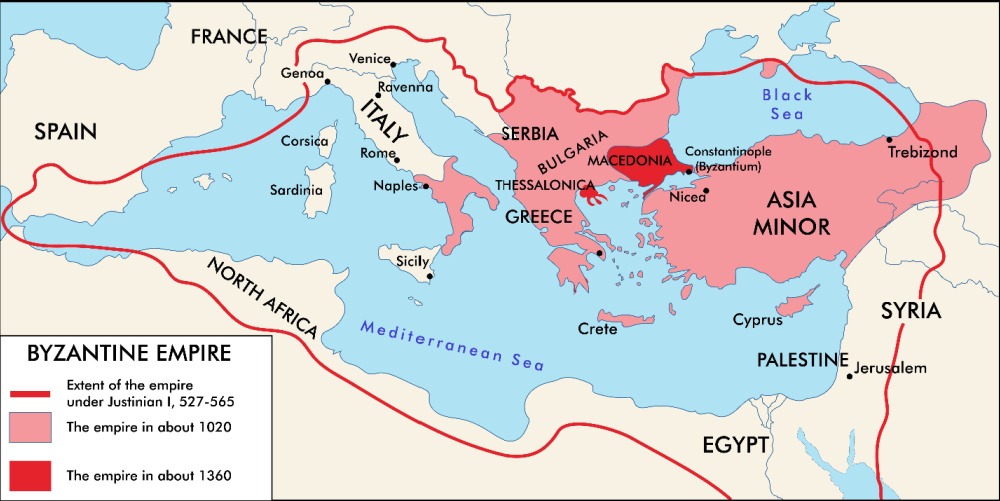
The term “Byzantine Empire” was not used by the empire’s own people and did not become common until many centuries later, well after the empire itself had ceased to exist. Medieval and early modern scholars adopted the term to distinguish Eastern Rome from ancient and medieval Western Rome, but this was a retrospective label rather than a contemporary reality. For nearly a thousand years after 476 AD, Eastern Romans lived, governed, worshiped, and fought as Romans, preserving imperial continuity until the fall of Constantinople in 1453.
The Role of the Church in Preserving Rome
The Christian Church became one of the most powerful vehicles for Roman continuity. As imperial authority weakened in the West, bishops and church institutions stepped into leadership roles once filled by Roman officials. The Church preserved Roman administrative practices, education, and written records. Additionally, the Eastern Empire expanded the reach of the church with the Hagia Sofia under Emperor Justinian.
Monasteries and cathedral schools safeguarded classical texts, while Church governance mirrored Roman bureaucracy. Through religion, Rome’s organizational genius survived and spread across medieval Europe.
A World Transformed, Not Destroyed
Modern historians increasingly reject the idea that Rome’s fall ushered in an immediate and total collapse. Instead, they describe a gradual transformation. Most academics now reject the classical tradition of referring to this period as the Dark Ages. Cities declined in some regions but persisted in others. Trade networks contracted but did not vanish. Roman architecture, roads, and urban layouts continued to shape daily life.
The transition from Roman rule to medieval kingdoms was uneven and complex, marked by adaptation rather than obliteration. Rome faded as an empire but endured as a civilization.
Rome as an Idea and Source of Authority
Even after Rome ceased to exist as a unified political entity in the West, it lived on as a powerful idea. Medieval rulers sought legitimacy by associating themselves with Rome. The concept of inherited imperial authority shaped institutions such as the Holy Roman Empire and influenced Renaissance thinkers who looked back to Rome as a model of order and greatness.
This symbolic survival ensured that Rome remained central to European identity long after its legions had disappeared. Every great empire in Europe following the fall of Rome repeatedly promoted itself as the rightful successor to the Roman triumph, from Charlemagne to Napoleon to the Romano Czars.
In effect, the Roman Empire did not die with Rome, it evolved
Rome’s survival after its fall was not the result of a single institution or empire, but of its extraordinary adaptability. Its laws, language, religion, administrative systems, and cultural ideals continued to function within new political realities. Rather than disappearing, Rome transformed itself and became the foundation upon which medieval and modern Europe were built.
In actuality, the Roman Empire is still very much alive in our modern world as is the division between the eastern and western empires. From the rift between geopolitical competition of “West vs East” to the divisions of the Catholic and the Orthodox Churches.
Rome did not simply fall into history. It lived on, reshaped by time, carrying its influence forward long after the empire itself had passed away. From our modern societal structures, government institutions, art and architecture, the Roman Empire is very much a part of the modern world.